
Dubai is opening thousands of new school places, but after a year of disruption, some families may find greater educational security outside the classroom.
Dubai will open 26 new private education institutions during the 2026–27 academic year, including seven schools, 17 early childhood centres and two higher education institutions. The schools will add 16,846 places, according to Dubai’s Knowledge and Human Development Authority (KHDA).
Four will offer the UK curriculum and three the International Baccalaureate (IB), including new Dubai campuses from Harrow, Queen Elizabeth’s School and Rugby School.
More choice is welcome. Yet these schools are opening after an academic year in which pupils across the UAE moved between classroom and distance learning because of the US–Iran war. Families considering a new school may therefore be thinking about more than curriculum, facilities and reputation. They may also want to know how reliably their child’s education can continue if circumstances change again.
For some families, a full-time, private tutor provides a more dependable alternative to school.
Are Dubai schools still affected by the war?
Dubai’s schools are open. Pupils returned for the 2026–27 academic year on 31 August 2026, and there is no current general requirement to learn from home.
However, Gulf News reports that authorities are continuing to monitor the regional situation and schools have retained their contingency plans.
The effects of the previous year may also remain for individual children. Some struggled with online learning, lost confidence or developed gaps in their knowledge. This is particularly concerning during GCSEs, A Levels or the IB Diploma, when there is less time to recover lost ground.
What would happen if Dubai schools closed again?
Schools would be expected to return to distance learning. This allows lessons to continue, but pupils still follow a school timetable online and teachers remain responsible for whole classes.
Parents considering one of the new schools should ask how it would:
move between classroom and online teaching;
assess and recover learning lost during a closure;
support children who struggle to learn online;
prepare examination pupils during disruption; and
teach a child whose family temporarily leaves the UAE.
New schools will have contingency plans, but these will not yet have been tested by their new teaching teams and pupil communities. Parents need to understand how a school would protect their child’s progress, rather than only which technology it would use.
Could rapid expansion affect teaching quality?
Dubai’s schools already compete for a relatively small and transient pool of experienced teachers and leaders. Opening seven more at once may increase staff turnover and make consistent teaching harder to maintain.
Education adviser Harry Sherratt raised this concern in our previous article.
While the international schools follow strong curricula, the population of teachers remains small and transient.
Tutors International is already seeing increased demand from families dissatisfied with their children’s school experience, even before this latest expansion.
Why choose a full-time private tutor instead of a new school?
A full-time private tutor can replace school completely, for a defined period or over several years. They can teach a recognised curriculum, prepare the child for examinations and organise a broad programme of academic, social, sporting and cultural activities.
This may appeal to families who want:
Continuity if they move. A travelling tutor can accompany the family if they leave Dubai temporarily, allowing the same education to continue in another location.
One consistent educator. The tutor knows what has been taught, where the gaps are and what the child should study next.
A curriculum taught at the child’s pace. A tutor can teach the British curriculum, IB or another agreed programme while spending more time where it is needed and moving quickly through material the child has mastered.
Time to assess a new school. Families can wait to see how its leadership, teaching, staff retention and culture develop before enrolling their child.
An education designed around future plans. The programme can support the child’s likely next school, examination route or university destination, even if the family expects to move again.
If circumstances change, the tutor can adjust the programme immediately. There is no need to wait for a whole institution to reorganise.
Is full-time tutoring only a temporary alternative to school?
No. Some families appoint a tutor for a term or a year while relocating, waiting for a school place or assessing their options. Others choose tutor-led home education for several years because it better suits their child or their international lifestyle.
A tutor may later prepare the child to enter or return to school. But if the child is progressing well, the family may decide to continue with private tutoring.
For families whose lives span several countries, this can help turn separate moves and school changes into one continuous educational plan.
Will a child miss out socially without school?
Full-time private tutoring can give a child more time for friendships and activities. One-to-one teaching is highly efficient, so academic work does not have to occupy the conventional school day.
The tutor and family can use that time for sport, clubs, music, volunteering, cultural activities, group classes and time with friends. These opportunities can be chosen around the child’s genuine interests and may involve a wider range of ages and backgrounds than a single school year group.
Social life needs to be considered as part of the educational plan, but it does not have to be difficult or limited. Often, it’s quite the opposite.
Can a private tutor teach the same curriculum as a school?
Yes. A suitably qualified tutor can teach the British curriculum, prepare a child for GCSEs or A Levels, or deliver an IB or other international programme. Tutors International recruits specifically for each family’s requirements, including the curriculum, subjects, qualifications and examination experience the child needs.
The difference is in how the curriculum is delivered. A school generally follows a set timetable and sequence for a class. A private tutor teaches the curriculum at the individual child’s pace, closing gaps, extending strengths and connecting subjects to their interests and surroundings.
Families should establish the intended qualifications and examination arrangements at the outset, particularly for older students.
How does a full-time tutor compare with a new Dubai school?
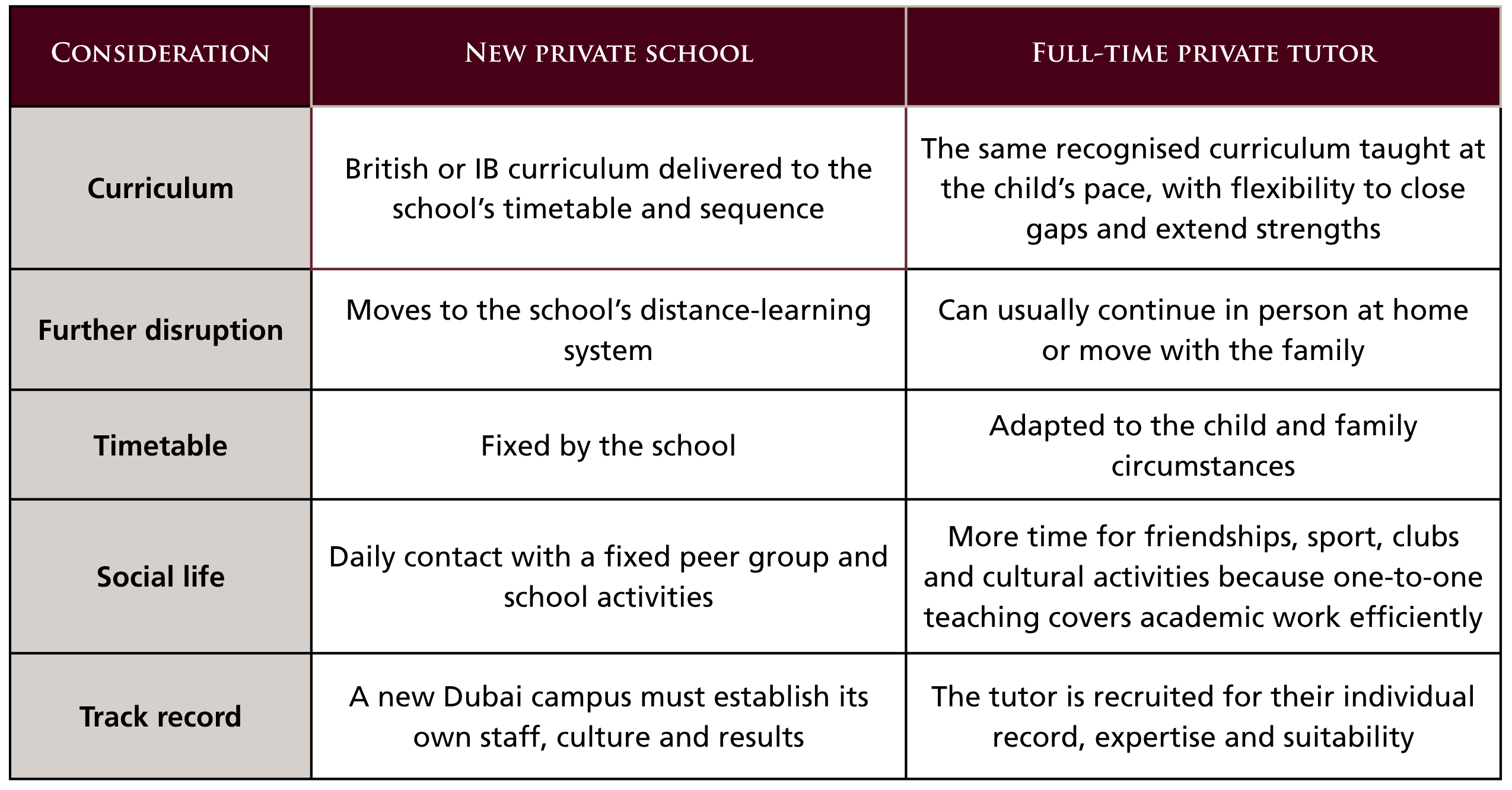
Some children thrive in a large school community. Others will make better academic and personal progress with the consistency, flexibility and individual attention of a live-in tutor.
What should families consider before replacing school with a tutor?
A successful full-time tutoring placement needs more than strong subject knowledge. Families should consider:
the curriculum and qualifications the child will follow;
the tutor’s experience with the child’s age, subjects and needs;
how specialist subjects and external examinations will be arranged;
which social, sporting and cultural activities will form part of the week; and
whether the tutor’s personality and approach suit the child and family.
That “glass-slipper fit” as we call it matters enormously. A full-time tutor becomes a significant and trusted presence in the child’s life, particularly during periods of uncertainty or relocation.
Adam Caller, CEO and founder of Tutors International:
Dubai's new schools open up more options for families, but a full-time tutor is worth just as serious a look. It gives a child a level of individual attention, flexibility, and pace that even an excellent school, with the best will in the world, can't fully replicate across a classroom of pupils.
Private tutoring is a genuine alternative to school in Dubai
Dubai’s seven new schools will give many families an option that suits their children well. But the previous academic year showed how quickly school-based education can be disrupted.
A school can respond by moving lessons online. A full-time tutor can preserve the child’s teacher, curriculum, routine and progress wherever the family is living.
For families concerned about further disruption, unsure about committing to a new institution or looking for an education built around their child, tutor-led home education is a serious alternative.
Tutors International recruits exceptional full-time private tutors to provide individually designed education in Dubai and around the world. Contact us to discuss whether full-time private tutoring is right for your child.
Frequently asked questions
Are Dubai schools currently open?
Yes. Dubai schools reopened for the 2026–27 academic year on 31 August 2026. Schools retain contingency plans in case distance learning is required again.
Can a private tutor replace school in Dubai?
A full-time private tutor can deliver a complete programme of home education. The curriculum, qualifications, examination arrangements and any applicable local requirements should be planned from the beginning.
Can the tutor travel if the family leaves Dubai?
Yes. A travelling tutor can accompany an internationally mobile family, subject to the agreed employment, visa and travel arrangements.
Can a privately educated child take recognised examinations?
Yes. Children educated outside school can prepare for qualifications such as GCSEs and A Levels. The available route depends on the curriculum and examination centre, so arrangements should be confirmed well before the examination year.
